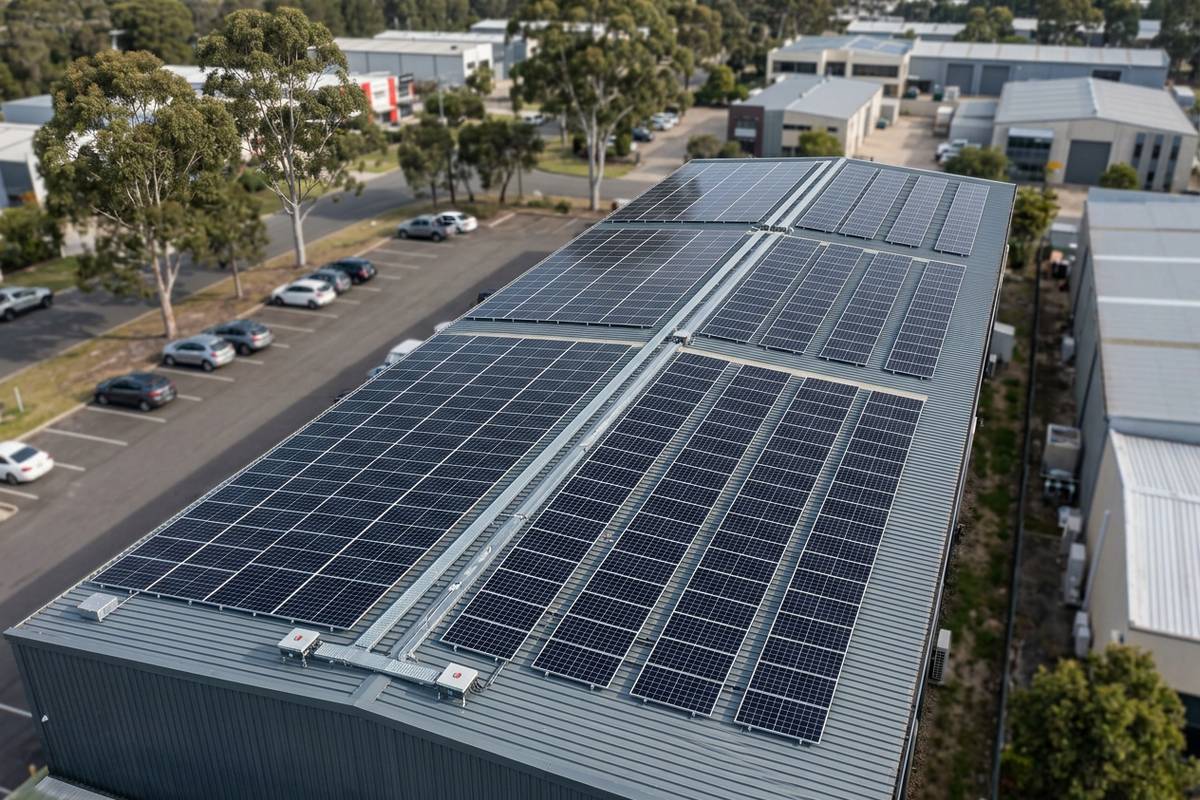
Commercial Solar for Central Coast Businesses
Most businesses run hardest during daylight — the exact hours a solar array is producing. That overlap is the whole reason commercial solar tends to pay back faster than residential: the power is consumed on site as it is generated, displacing electricity bought at commercial rates rather than being exported for a low feed-in return. For the right premises, it is one of the more dependable investments a business can make in its own running costs.
Why Daytime Load Is the Key
The value of commercial solar lives in self-consumption. A workshop, retail space or warehouse drawing power all day uses what the roof makes the moment it makes it, so very little is exported and almost all of it offsets expensive grid power. The closer your usage pattern matches the generation curve through the middle of the day, the harder the system works for you — which is precisely why a sound commercial design starts with your load profile, not just the size of your roof.
Reading Your Load Profile
A commercial design looks closely at when and how much power you draw across the day and the week. A business running machinery from early morning has very different ideal sizing from one that peaks at midday or trades into the evening. Matching the array to that profile is what turns a roof full of panels into a genuine, lasting cut in operating costs rather than a system that exports its best hours for next to nothing.
Roof, Supply and Connection
Commercial sites bring their own considerations. Roof areas are larger and access can be more involved; supply is often three-phase; and network connection rules for commercial systems differ from the residential ones. The switchboard and incoming supply are assessed to confirm what can be connected and how much can be exported. Larger systems in particular may have export limits the design has to be built around from the start.
The Business Case
Beyond the headline bill reduction, commercial solar can bring tax depreciation benefits and act as a hedge against rising energy costs across the system's working life. That combination is what makes the numbers work for many Central Coast businesses, from light industrial sheds to retail and hospitality. A proper proposal models your actual usage and supply rather than quoting a generic payback figure that may have little to do with your premises.
Keeping the Premises Running
A commercial install is planned around your trading hours so the disruption to the business is minimal — work is staged, and any brief shutdown to tie the system into the board is scheduled when it hurts least. The aim is a system that starts cutting costs without the installation itself costing you a day's trade.
Monitoring and Maintenance for Business Systems
A commercial system is an operating asset, so it is worth watching. Monitoring flags a dropped string or an underperforming inverter before it quietly eats into the savings the system was bought for, and periodic servicing keeps a larger array in good order. For a business, lost generation is lost money, so the case for keeping an eye on performance is even stronger than it is on a home.
Three-Phase Supply and Larger Systems
Most commercial premises run three-phase power, which opens up larger inverters and bigger arrays than a typical home supply allows. It also brings stricter network requirements around how much a system can export and how it connects, which is why a commercial design always starts by confirming the incoming supply and switchboard capacity. A system that looks fine on the roof can still be limited by what the connection permits, so the supply assessment is not a formality — it shapes the whole design. Getting it right upfront avoids a system that is either oversized for what it is allowed to export or undersized for what the business actually draws, and it keeps the connection application moving without surprises.
Frequently Asked Questions
What shapes the cost of a commercial system?
System size, roof type and access, whether the supply is single or three-phase, and any switchboard or connection upgrades needed. Each is assessed on site so the proposal reflects your premises rather than an average.
Will solar cover all of my business's power?
Rarely all of it, but a well-sized system covers a large share of daytime load, which is where the savings concentrate. The aim is the strongest return on the system, sized to what you actually use.
Does commercial solar need different approvals?
Yes — commercial connections and larger systems follow different network rules from residential, including possible export limits. These are handled as part of the design and application process.
How disruptive is a commercial install?
It is planned around your trading hours, with any brief shutdown scheduled to minimise impact. Most of the work happens on the roof while the business carries on below.
Run a Business on the Central Coast?
Commercial solar pays back hardest when your operations run through daylight hours. Talk to a local licensed installer about a system scoped to your site and load profile — chat with our team for a free, no-obligation assessment.